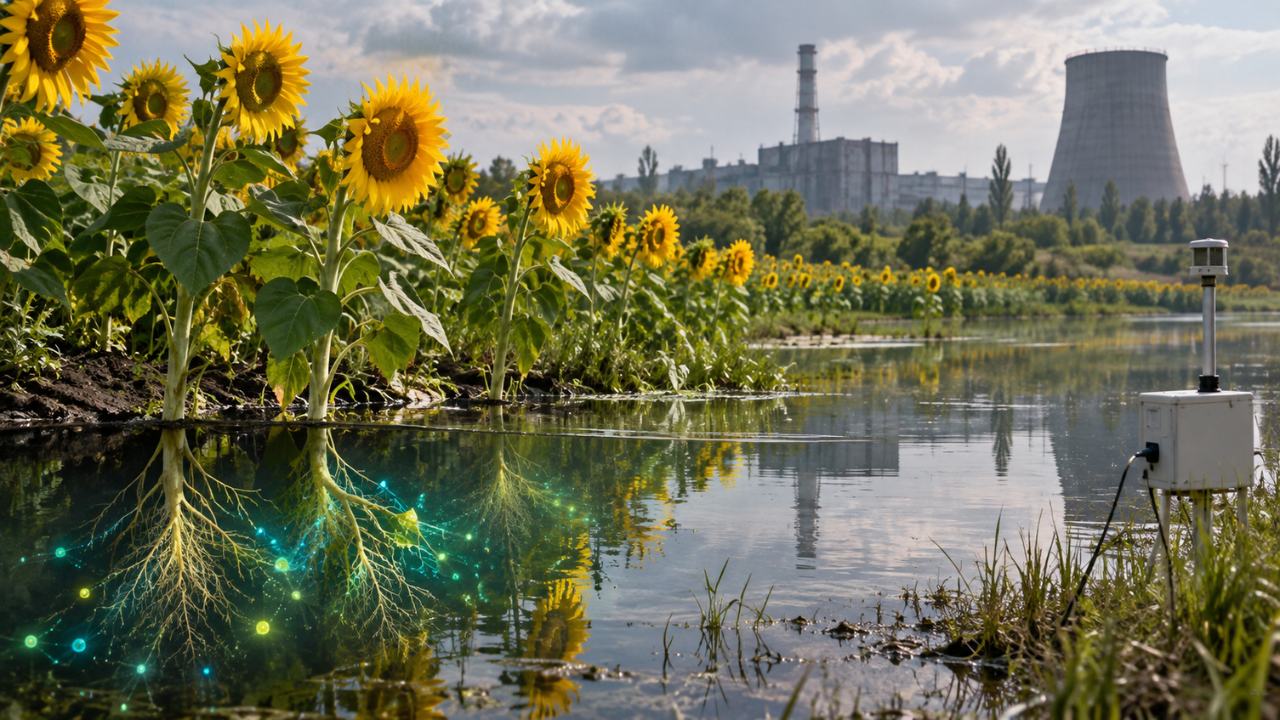
Radioactive fallout doesn't care about your clean-up plans. When reactor number four blew up at the Chernobyl Nuclear Power Plant in April 1986, it hurled a massive cloud of toxic isotopes across Europe. Tons of strontium-90 and cesium-137 leaked into nearby soils and water systems. Traditional remediation methods meant scraping up massive amounts of topsoil and burying it in expensive, giant concrete tombs. That strategy costs a fortune and ruins local ecosystems.
So researchers turned to biology instead. They looked at nature's own filtration system.
Scientists planted millions of sunflowers near the disaster zone. It sounds like a quirky garden experiment dreamed up by optimists. It was actually hard science backed by botany. Those bright yellow blooms weren't just there for a morale boost. They were deployed as living vacuum cleaners designed to scrub poisons right out of the environment.
You might think plants just sit there looking pretty. They're actually chemical processing factories.
The Science Behind Botanical Clean Up
Phytoremediation is the formal term for using plants to clean up polluted environments. But forget the textbook definition. Think of it as a sponge operation. Sunflowers are hyperaccumulators. That means they take up heavy metals and chemical elements from their surroundings at rates far higher than normal plants.
Cesium-137 and strontium-90 look chemically similar to nutrients that sunflowers crave. Strontium mimics calcium. Cesium mimics potassium. The roots slurp up water and soil moisture, unable to tell the difference between healthy minerals and radioactive isotopes. The plant pulls these toxic atoms upward and stores them safely inside its stems and leaves.
It works with water too. Years after the initial catastrophe, agricultural engineers tested floating rafts of sunflowers on contaminated ponds near the power plant. The root systems dangled directly into the water column. Within days, the roots stripped away massive concentrations of radioactive contaminants.
Mother Nature did the heavy lifting for free.
Why This Strategy Works in the Real World
People often assume nature handles toxic waste easily. Reality is messier.
You can't just throw sunflower seeds anywhere and walk away. Soil chemistry matters immensely. If the earth is too acidic or lacks basic organic matter, plants won't grow fast enough to make a dent in the pollution. Agronomists had to test various fertilizer blends to get those Chernobyl sunflowers to sprout in scarred earth.
Once the sunflowers finish their job, you face a new problem. What do you do with a field full of radioactive flowers?
You can't throw them in a standard compost bin. You treat them like hazardous industrial waste. Crews harvested the mature plants, dried them out, and burned them or buried them in secure radioactive waste repositories. The total volume of waste dropped dramatically compared to hauling away millions of tons of raw, contaminated dirt.
Volume reduction changes the economics of disaster recovery entirely. Instead of moving an entire mountain, you move a few barrels of ash.
Limitations Most People Ignore
Let's clear up a major misconception. Sunflowers are not a magical cure-all for nuclear meltdowns.
They won't solve a deep underground leak overnight. Roots only reach down a few feet. If heavy isotopes sink deep into the water table, sunflowers can't touch them. You need deep drilling or chemical injection barriers for that kind of scale.
Sunflowers also take time to grow. In a sudden emergency, you can't wait four months for a seed to mature into a functional filter. They work best for long-term stabilization, polishing dirty water, and reclaiming abandoned agricultural lands decades after the worst phase of a disaster passes.
Using biology requires patience. Humans hate patience when radiation alarms are screaming.
What You Can Learn From This Environmental Win
You don't need a nuclear reactor meltdown to use phytoremediation. Homeowners and city planners use similar botanical tricks today.
If you buy an old industrial plot to build a house or business, check the soil history first. Don't guess what's hiding under the grass. Hire a testing lab. If heavy metals like lead or zinc show up, certain mustard plants, poplars, or willows can clean up the dirt over a few seasons without excavation equipment chewing up your budget.
Nature wants to heal damaged spaces. You just have to pick the right green partner for the job, get out of the way, and let the roots do their work.


