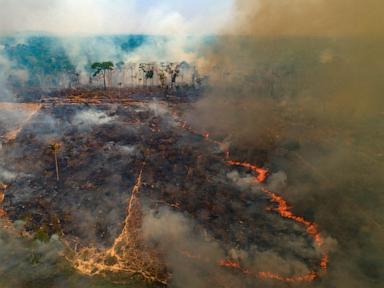
Smoke chokes the sky over the Amazon while world leaders pat themselves on the back for another corporate announcement. A freshly minted $100 million firefighting initiative just rolled out during the United Nations General Assembly and New York Climate Week. Sounds impressive on paper, right? It isn't. When you look at the math, that pocket-change amount vanishes against a multibillion-dollar deficit needed to keep tropical forests from burning to the ground.
If you think a single philanthropic pool will stop the infernos chewing through South America, you're missing the bigger picture. The numbers don't add up, and the structural gaps left behind expose a dangerous illusion of progress.
The Real Scale of the Shortfall
Let's look at the actual data released by the U.N. Sustainable Development Solutions Network. Conserving and restoring tropical forests requires an extra $66.8 billion by 2030. Back in 2023, total funding stalled at a meager $14.6 billion.
Now look at the new fund anchored by a $30 million contribution from the Gordon and Betty Moore Foundation and $5 million from the David and Lucile Packard Foundation, directed by groups like Renaissance Philanthropy and Conservation X Labs. It aims to pull together $100 million total for South America.
It is a drop in an ocean of ash.
When regional drought and intense heatwaves fueled by El Niño turn ecosystems like the Amazon, the Pantanal, and the Chiquitano dry forest into tinderboxes, a hundred million dollars won't buy enough boots on the ground or aerial support to make a dent.
Who Gets Left Behind in the Smoke
South America isn't the only place burning. The new money targets the Amazon basin, drawing inspiration from localized wins like Bolivia’s 15-year-old Indigenous fire brigade network and Brazil's fire-detection camera systems. Those local models work brilliantly. They empower communities who actually know how to manage the land.
Yet, Southeast Asia and vast regions of Africa received zero coverage under this new initiative.
Climate change doesn't care about geographic fundraising boundaries. Burning fossil fuels and shifting weather patterns push fire risks across continents. When international support remains piecemeal, countries outside favored philanthropic zones are left to handle catastrophic fire seasons with local budgets that dry up faster than the brush.
Why Rain Forests Burn
Rainforests aren't naturally meant to catch fire. Unlike savannas, they lack evolutionary defenses against heavy blazes. They rely on dense, wet canopies to retain moisture.
Kumar Garg of Renaissance Philanthropy put it bluntly during the rollout: "We're at the possibility that we might lose the Amazon altogether, and once we lose the Amazon, we don't get it back—the next couple of years are really going to matter."
Here is the part most headlines gloss over. The Amazon doesn't ignite spontaneously from a dry leaf rubbing against another. As Conservation X Labs leader Alex Dehgan points out, nearly every single fire in the basin is lit by human hands. It is a deliberate choice or a careless mistake tied to agricultural expansion, land clearing, and deforestation.
If humans built the systems driving the crisis, throwing money at suppression rather than changing economic drivers of deforestation is like trying to bail out the Titanic with a teaspoon.
What Wealthy Nations Keep Getting Wrong
Many wealthier countries operate under a dangerous delusion. They assume they can adapt to climate impacts locally once things get bad enough, rather than investing massive sums upfront in global mitigation and prevention.
That strategy fails because carbon loops don't respect borders. When the Amazon or Southeast Asian rainforests turn from carbon sinks into massive carbon emitters—breaking records like they did recently—the entire planet pays the price in accelerated warming.
Fragmentation breaks up continuous blocks of forest, creating dry, flammable edges. Without coordinated, multi-billion-dollar systemic funding that covers all tropical zones, isolated philanthropic wins remain vulnerable to the next severe dry season.
If you want to support genuine ecological resilience, look past the press releases of newly launched funds. Push for accountability that targets the root causes of land clearing, supports Indigenous-led fire management networks directly, and demands that international donors close the actual $50 billion-plus gap before the next dry season rolls in.