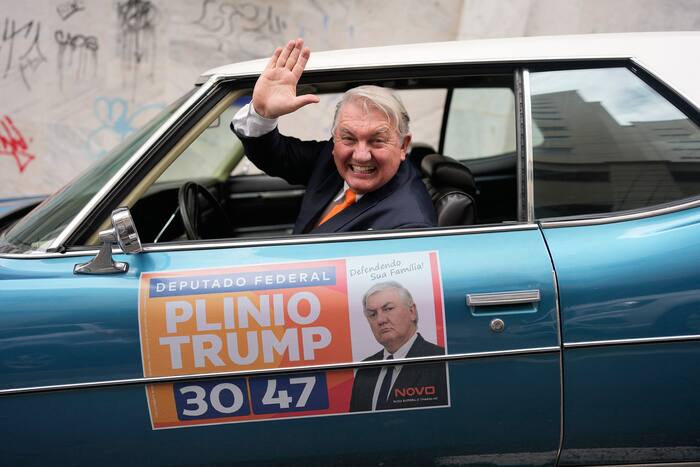
You walk down a street in Juiz de Fora, and a vintage Pontiac Grand Ville rolls past. An American flag flutters near the windshield. Inside sits Plínio Vicentin Júnior, a helicopter pilot campaigning under the name Plínio Trump. He wears a long orange tie, sports a familiar hairstyle, and hands out firm handshakes. He is one of thousands running for office in Brazil, but he is part of a much wilder, decades-old political tradition.
Brazil has spent nearly eighty years treating ballot boxes as a stage for protest candidates, joke figures, and bizarre political aliases. While outsiders might laugh, this phenomenon is deeply strategic, highly calculated, and rooted in serious voter frustration. Let’s look at why Brazil’s joke candidates matter, how the system actually rewards them, and what this says about modern democracy.
The Evolution of Protest Politics in Brazil
The tradition didn't start with human beings impersonating foreign leaders. In 1959, voters in São Paulo grew so fed up with local corruption that they wrote in Cacareco, a female rhinoceros from the city zoo, for a city council seat. Roughly 100,000 ballots bore her name before election authorities invalidated them.
The strategy went underground during the military dictatorship from 1964 to 1985, but roared back to life when democracy returned. In 1989, Dr. Enéas Carneiro ran for president. A respected cardiologist, he delivered frantic, rapid-fire speeches during compressed 15-second television spots, ending every ad by screaming, "My name is Enéas!" People laughed, but he pulled in hundreds of thousands of votes. Five years later, riding a wave of anti-corruption anger following the impeachment of President Fernando Collor, Carneiro finished third with 4.6 million votes.
By 2010, the movement peaked when Tiririca, a famous circus clown and comedian, won a congressional seat for São Paulo with over 1.3 million votes. His campaign slogans were brutally honest about voter apathy. "It can't get any worse," he told voters, asking, "What does a federal congressman do? I really don't know. Vote for me and I will find out for you." Tiririca didn't flame out after one term; he served four consecutive terms and secured tens of thousands of votes in later cycles.
Meet the Ballot Characters of Today
Fast-forward to current elections, and the ballot reads like a bizarre cross between a Hollywood casting call and a meme generator. Plínio Trump is just one player on a crowded field.
Consider Cláudio Henrique dos Anjos, who runs under the name Henrique Barack Obama. He is seeking a Senate seat for the Federal District, though locals note he mostly channels the former U.S. president through his posture and love of attention, having previously dressed up as Obama during soccer matches.
Then there is Walcy Calixto Vieira, a 66-year-old carpenter with shaggy bangs who runs under the moniker Mick Jagger. Other candidates skip celebrity impersonations entirely in favor of surreal nicknames. Scheile Aparecida Soares Brandão campaigns as "Tsunami Grandmother." Francisco das Chagas Costa Oliveira runs as "Who Who." Marcelo da Rosa is a truck driver campaigning under the alias "Lonely Boy." Meanwhile, Severino Cardoso Sobrinho—better known as the "Samurai Taxi Driver"—utilizes nunchaku master routines in Instagram videos to run for the state legislature in Pernambuco.
These aren't just random eccentrics looking for a quick laugh. To run, they must belong to one of Brazil's registered political parties and meet strict eligibility requirements, including clean-record laws.
The Math Behind the Madness
Why do political parties welcome these eccentric figures? The answer lies in Brazil's proportional representation system.
Political science professor Carlos Melo from Insper university in São Paulo points out that novelty candidates punch above their weight because of how votes are distributed. Even if a joke candidate doesn't pull enough raw votes to win an outright seat, their individual numbers get pooled into their party's total.
Those extra thousands of votes help parties secure a bigger slice of Congress. More importantly, it unlocks more public campaign funds for the very party apparatus that disillusioned voters are trying to protest. Protest votes don't dismantle the system; they often feed it funding through the back door.
Voters turn to these candidates because traditional political leadership has lost credibility. When mainstream politicians are viewed as out-of-touch or corrupt, casting a ballot for a clown, a fictional rocker, or Plínio Trump becomes a middle finger to the establishment. It is a way to say the system is a joke, so the vote will match it.
If you are looking at how public sentiment shifts during election cycles, watch where the frustration goes. When institutional politics hollows out, absurdity fills the vacuum. Brazil proves that when voters feel ignored, they won't just stay home—sometimes, they will elect a rhinoceros or a local taxi driver to prove a point.